
This surgical technique was performed for the first time in Liège, Belgium, by Dr Mitiku Belachew, a Belgian-Ethiopian surgeon, in 1993.
While gastric banding was widely used in its early days, it has been in major decline for over 10 years. It is nowadays reserved for very specific cases, given the high rate of complications and its poorer long-term results. The current trend is to remove bands placed over 10 years ago, in case of (verifier le sens, je suis pas sûr de ce que tu veux dire en français: on les retire d’office ou que si complications / pas de perte de poids ?) complications and/or failure to lose weight. The standard conversion therapy for these patients is gastric bypass, which can be performed during the same operation as the band removal.
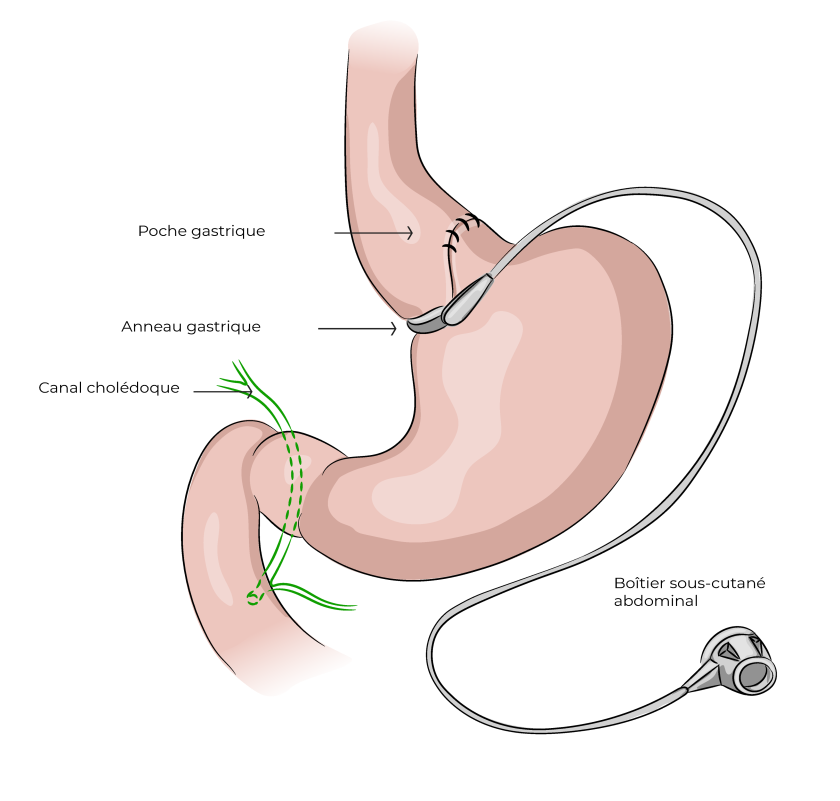
A gastric band is an adjustable silicone sleeve connected to an access port, placed under the skin, with a catheter (tube). The access port is placed in front of the muscle, under the sternum or on the left flank.
It is an intervention which reduces the volume of the stomach and slows down food upstream of the band, hence increasing early satiety (fullness) and reducing food intake.
Gastric banding does not involve stapling or digestive suturing, which is why it is associated with low post-operative death rates. However, post-operative weight loss and improvement of comorbidities such as type 2 diabetes are much worse than for sleeve gastrectomy or gastric bypass.
The ring is adjustable, i.e. it can be inflated or deflated with a liquid solution, depending on the patient’s response. Unwanted self-inflation phenomena may appear over time, which may lead to inability to eat (dysphagia) or complete blockage, requiring emergency deflation.
Gastric banding has an average excess weight loss of 40%.
The procedure usually lasts less than an hour and is almost always performed using celioscopy.
The patient may usually return home the next day but, under certain conditions, they may even return home the same day.
The operative mortality of the procedure is lower than 0.1%.
The surgery is considered reversible, which may sound enticing, but it is important to note that the conversion surgery is more difficult and more risky. This is due to the apparition of scarring tissue on the upper part of the stomach, as well as an imprint left by the band and the valve that prevents sliding. In addition, patients who have underwent gastric banding very often lose significantly less weight when performing a different bariatric surgery after a failure of the first. This is due to the body metabolism adapting to food restrictions.
The fact that sleeve gastrectomy is also a restrictive procedure partly explains why its results after gastric banding aren’t as good as those of gastric bypass after gastric banding. Of course, the great majority of patients put weight back on after removal of the gastric band.
If a removal of the gastric band is considered, it is imperative to perform a gastroscopy to ensure the absence of intra-gastric migration of the band; in which case the ring must be removed endoscopically.
The main complications of gastric banding are infection of the access port (requiring its removal), slippage of the band, migration of the band inside the stomach, gastroesophageal reflux (which can lead to esophagitis), esophageal motility disorders and intestinal obstruction from rotation of the intestine around the catheter. These complications are relatively frequent (about 30% in the long term).