There are about forty different bariatric interventions. Some have become standard, such as gastric sleeve or gastric bypass, while others have significantly regressed due to poor results and complications, such as gastric banding. Some must be carried out in very specific and rare cases of extreme obesity or obesity refractory to other procedures, with close supervision in an expert center, because of malnutrition and severe protein and vitamin deficiencies risk. Many new surgical techniques are still pending validation. Here is a link to a summary of the different interventions from the French National Authority for Health (Haute autorité de santé française (HAS) and SOFFCO-MM (Société française et francophone de chirurgie de l’obésité et des maladies métaboliques).
Although it is difficult to know exactly which procedures are carried out by different countries, since certain interventions are codified locally, gastric bypass is, by far, the most frequently used intervention in Belgium, while it is sleeve gastrectomy in France. Gastric banding, given its high rate of complications (around 30%), and the weaker long-term results, should be reserved for a minority
The surgery
of obesity

All our interventions
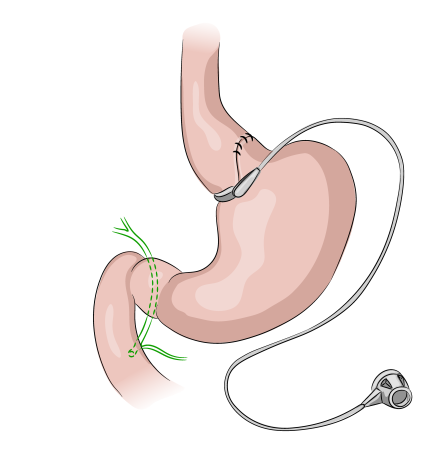
Gastric banding
While gastric banding was widely used in its early days, it has been in major decline for over 10 years.

Sleeve gastrectomy
Sleeve gastrectomy is another restrictive technique, which consists in a partial resection (removal) of greater curvature of the stomach

Gastric bypass (Roux-en-Y)
The technique is both restrictive and malabsorptive. A small gastric pouch (neogastrium, the size of a tennis ball) is created (using a calibration probe) to reduce the size of the stomach and food contact.

Preoperative assessment
Since obesity is multifactorial, we carry out a complete general health assessment prior to the intervention, involving all of our medical and paramedical specialists.

May I be approved for bariatric surgery?
In Belgium, there are legal criteria in order to be allowed reimbursement for bariatric surgery.

Postoperative follow-up
In our medico-surgical obesity clinic, we provide lifelong follow-up to operated patients.

Preoperative assessment
Since obesity is multifactorial, we carry out a complete general health assessment prior to the intervention, involving all of our medical and paramedical specialists. Certain tests are systematically carried out in order to detect certain obesity-related diseases: a complete blood test, an advanced cardio-respiratory assessment, a gastroscopy and an abdominal ultrasound. Other, case-by-case specific tests may be added to the list depending on the findings of prior tests (psychiatric opinion, dentist check-up, preoperative physical conditioning or kinesitherapy, etc.).
After the preoperative assessment, the patient’s case is discussed in a multidisciplinary meeting in order to evaluate the relevance of surgery. These meetings take place once a month and involve the entire Obesity Clinic team. These meetings don’t happen behind closed doors and we invite you to attend if you wish to discuss your case. The necessity for extra specialist consultations may be requested before the intervention in order to perform it at a more opportune moment. If the team approves the surgery, a reimbursement request is sent to INAMI, who must also approve. Once this happens, an operation date can be agreed upon.
The minimal time between the first consultation and the intervention is three months. It can take up to several years if the situation requires it. We find it critical to offer the intervention at the best moment of the process, when the patient is completely ready. The idea is to optimize health status, to offer sufficient time for reflection and to communicate all the key therapeutic education elements, to maximize the chances of success of the intervention.
We don’t operate patients with active alcohol consumption (because of: difficulties to follow nutritional advice, high alcohol caloric intake, physiological digestive changes) and we require a complete tobacco cessation for at least one month prior to the intervention, as tobacco multiplies the risk of surgical complications by four. Guidance and support on how to quit smoking is offered by our team. Pregnancy during one year post-intervention is strongly discouraged, to avoid the consequences of a possible nutritional deficiency in the unborn child. An effective contraceptive method is therefore strongly recommended.
In women, fatty tissue is mostly found underneath the skin. It is referred to as subcutaneous adipose tissue (SAT) and an excess of it is referred to as “gynoid obesity”.
In men, fatty tissue is mostly found in the abdomen, between the internal organs. It is referred to as visceral adipose tissue (VAT) and an excess of it is referred to as “android obesity”. This is important, as often excess fat between the organs reduces the mobility of the intestine and the ability to perform a gastric bypass.
May I be approved for bariatric surgery?
In Belgium, there are legal criteria in order to be allowed reimbursement for bariatric surgery. At Sainte Elisabeth, we are committed to never breach these criteria, even if you have the means to finance all costs related to the intervention yourself. The reason is that bariatric surgery comes with severe risks, including death, and that alternative solutions exist for less severe cases.
- A documented dietary therapy for at least one year prior, with no stable results
- BMI >40 kg/m²
- BMI >35kg/m² with arterial hypertension, sleep apnea syndrome or type II diabetes
- A new surgical intervention after failure of a previous intervention and BMI >35 kg/m²
Even if we only operate on patients who have access to reimbursement from the Belgian system or an insurance company, who will pay most of the bills, a small part of the total costs will have to be financed yourself (around 1300 euros).
Complications such as severe gastroesophageal reflux after gastric banding or sleeve gastrectomy sometimes require conversion to a gastric bypass, which is not covered by the INAMI for bariatric surgery.
For patients who do not meet the INAMI reimbursement criteria, non-surgical treatment and support is provided by our Obesity Clinic. This consists in: screening and treating comorbidities, optimal dietary and psychological care, pharmacological treatment (drugs which cause weight loss such as GLP1 analogues used in diabetology) in certain cases. Pharmacological treatments pose risks, have side effects and they are not covered by the Belgian healthcare (except in very specific cases).
The placement of a gastric balloon can also be discussed, as long as it is part of a global care plan, in order to maximize the chances of success.

For patients who do not meet the criteria for reimbursement by the INAMI, non-surgical treatment is also provided at our bariatric clinic. This consists of screening and medical treatment of co-morbidities, optimal dietary and psychological management, and sometimes pharmacological treatment with weight-loss drugs such as the GLP1 analogues used in diabetes. There are also side effects to these treatments and they are not reimbursed in Belgium except in very specific cases. The placement of a gastric balloon can also be discussed, as long as it is part of a global management to increase the chances of success.
What are the contraindications to bariatric surgery?
- Age below 18 years old (although performed in some specialized centers) or above 65 years old (given the greater chances of failure)
- Active alcohol addiction and/or use of psychoactive substances (legal or not)
- No prior medical care
- Suffering from a disease endangering life in the short and medium term
- Having contraindications to general anesthesia
- Foreseeable inability to participate in a long-term medical follow-up (lack of compliance)
- Severe and unstable psychiatric disorders
- Serious depression with suicidal risk
- Severe and unstable eating disorders
- Severe cognitive or mental disorders

Postoperative follow-up
In our medico-surgical obesity clinic, we provide lifelong follow-up to operated patients. Follow-up consultations are held closer during the first year (every month, then every 3 months), to optimize care and detect complications, particularly nutritional ones. The follow-up is then gradually spaced out (every 6 months, then every year, etc.) but we always remain available to the patient and his general practitioner.
Medical follow-up is coordinated by the medical doctor and nutritionist, who also refers patients to other specialists when needed. Dietary monitoring is carried out by the dietist, who helps with dietary adaptations in link with the new, post-operative anatomical state. Psychological follow-up with the psychologist is offered upon request. This is often crucial, as significant weight loss may have serious psychological and social repercussions.
Significant weight loss secondary to bariatric surgery may cause development of excess skin in different places (abdomen, arms, buttocks, etc.), which may be bothersome.
The plastic surgeon, is in charge of all aesthetic repercussions linked to weight loss. He can advise you and give you an estimate of the surgical costs. However, better results require a stable weight, often achieved 2 years after surgery.
Belgian healthcare may partly reimburse abdominoplasty (resection of skin and abdominal fat) following bariatric surgery if strict INAMI criteria are met. In our obesity clinic, we offer to carry out this intervention without the additional legally imposed fees to patients who cannot finance the aesthetic treatment themselves, as long as the reimbursement criteria are met.
Belgian healthcare may partly reimburse abdominoplasty (resection of skin and abdominal fat) following bariatric surgery if strict INAMI criteria are met. In our obesity clinic, we offer to carry out this intervention without the additional legally imposed fees to patients who cannot finance the aesthetic treatment themselves, as long as the reimbursement criteria are met.
The general practitioner plays a major role in postoperative follow-up. Through therapeutic education, he will reinforce the results obtained at our obesity clinic. A close follow-up in general medicine helps to maintain a good dietary hygiene and the measures essential to stabilize weight over the long term. He adapts the usual medication in line with the weight loss and blood sugar levels changes, detects any possibly arising complication, helps with alcohol and tobacco cessation, encourages physical activity, etc.
This interaction between general medicine and our specialized multidisciplinary center enables a global patient care, in order to maximize the results of bariatric surgery.