
This technique is attributed to Dr. Doug Hess in 1988, in Ohio (USA), who developed another more complicated procedure called the duodenal switch. Slowly, sleeve gastrectomy has become a full-fledged procedure with an interesting benefit-risk ratio, and has become the most used bariatric surgery in France and the second in Belgium.
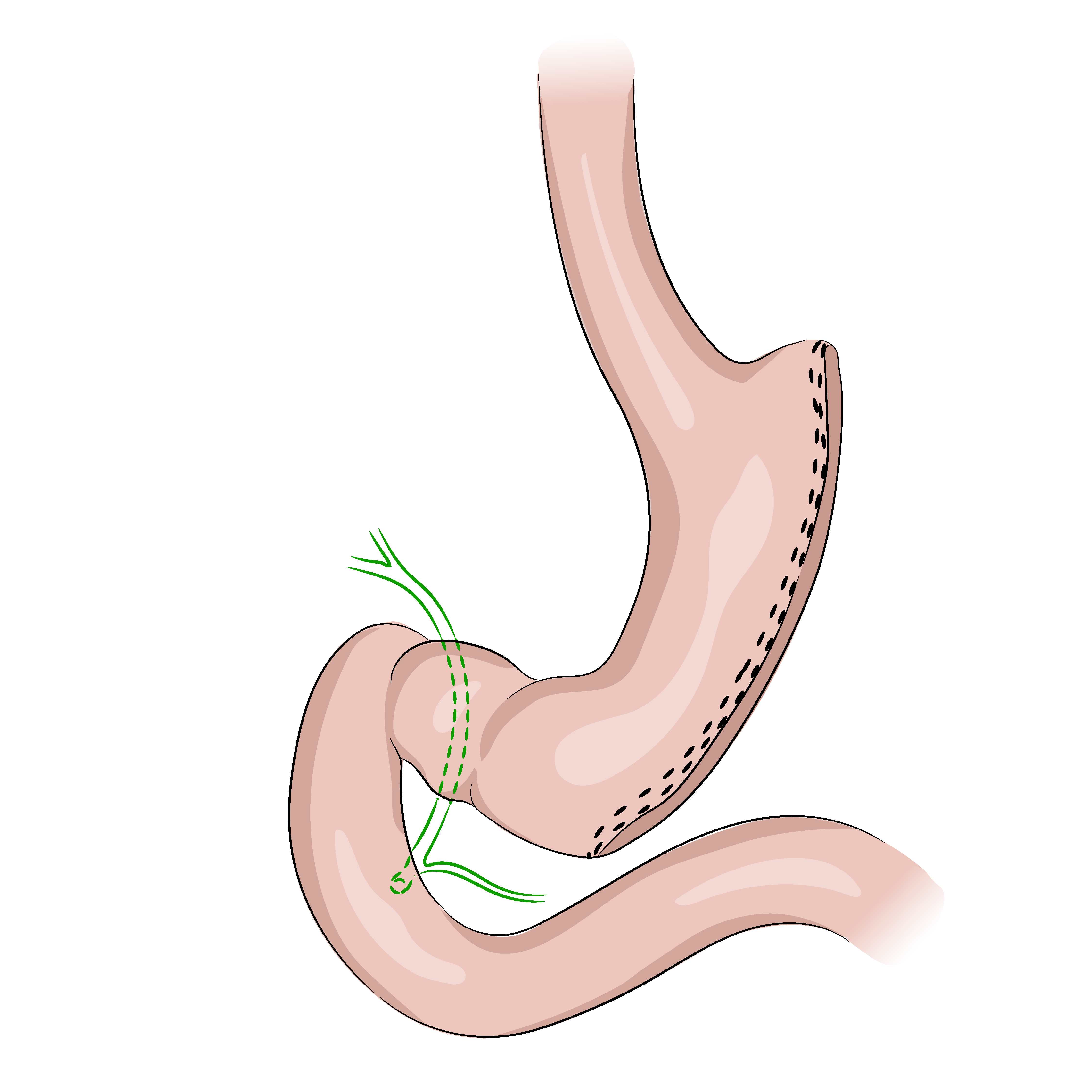
Sleeve gastrectomy is another restrictive technique, which consists in a partial resection (removal) of greater curvature of the stomach. The digestive continuity remains intact and the gastric antrum (bottom part) is preserved. A hormonal effect is added to the restrictive one because the upper part of the stomach (fundus), which produces an appetite-stimulating hormone, is removed during the surgery.
An adjustment of the size of the remaining “sleeve” is always performed (to match a standardized size, using a probe passing through the mouth) to avoid a narrowing (stenosis) of the sleeve. Stenosis can cause food blockages and upstream hyperpressure that can lead to leakage (fistula) of the stomach. On the other hand, if the sleeve is too large, the surgery may be ineffective, especially if the fundus was not removed.
The procedure lasts about an hour and is almost always performed by laparoscopy. Patients usually stay hospitalized for two nights after the surgery.
Given its overall smaller complications rate, sleeve gastrectomy may be used as a first step in a two-stage surgery for “super obese” patients (BMI > 50 kg/m²).
The average excess weight loss is 50% after 2 years. Classically, the weight loss is rapid during the first 6 months, after which a slight rise is observed, before long term stabilization.
One of the main complications of sleeve gastrectomy is leakage (fistula), along the staple line, in approximately 2% of cases. This is often a therapeutic emergency, as it may lead to death from peritonitis. Other possible complications are hemorrhage, stenosis, ulcer, gastroesophageal reflux and nutritional deficiencies.
This technique is contraindicated in patients with Barrett’s esophagus (pre-cancerous disease with an esophageal cancer risk around 0.5%), a severe gastroesophageal reflux or a large hiatal hernia.
The operative mortality of the procedure is around 0.08%.
Sleeve or bypass? How to choose your bariatric intervention?
The patient chooses the intervention after having received the most complete and accurate possible information, and a period of reflection. It is your body. Our role is to guide you towards the best choice, based on your medical and surgical history. For example, in the event of pre-existing gastroesophageal reflux or severe diabetes, a gastric bypass will be preferred. In the event of essential medication intake (which shouldn’t be malabsorbed) or history of abdominal surgery (below the stomach, with risks of adhesions and lesser freedom of the small intestine), a gastric sleeve should be preferred.